 Aviation State Engagement Forum
On this page
Closed consultation

Submit feedback to
Joint Airspace Control Cell
Royal Australian Air Force
Australian Defence Force
The Joint Airspace Control Cell (JACC) requests feedback on two proposed permanent restricted areas in support of biannual Australian Defence Force (ADF) amphibious exercises in North Queensland.
The issue
This proposal notes the following key issues:
- Establishment of two permanent Restricted Areas (RA) to safely segregate civil aircraft from military flying activities in the vicinity of Cowley Beach.
- Proximity of RA’s to Innisfail aerodrome (YIFL), local parachuting areas and coastal scenic route adjacent to Cowley Beach.
- Proximity of RA’s to YIFL Instrument Flight Procedures (IFPs).
Purpose
JACC requests feedback on two proposed permanent restricted areas in support of biannual ADF amphibious exercises in North Queensland.
Proposal
OVERVIEW
The ADF conducts amphibious exercises in the Cowley Beach region on a regular basis, which has previously necessitated the activation of Temporary Restricted Areas (TRAs) to ensure the safety of non-participant aviation activities.
Amphibious exercises utilise a wide variety of aviation platforms including; rotary wing, tiltrotors, fixed wing and Unmanned Aerial Systems (UAS) across the spectrum of weight categories. The density of traffic created by these exercises along with the different performance levels of each system result in an inability to operate within Class G airspace safely alongside non-participants.
The proposed volumes will have an impact on YIFL IFPs with the likely outcome a requirement to obtain transit clearance through RA when active.
It is expected that these volumes will be activated up to twice yearly for up to two weeks at a time.
PROPOSAL
Background
In recent years, Defence has conducted a number of amphibious exercises in the Cowley Beach region that have utilised two different airspace configurations to safely segregate non-participant aircraft.
The two configurations utilised are as follows:
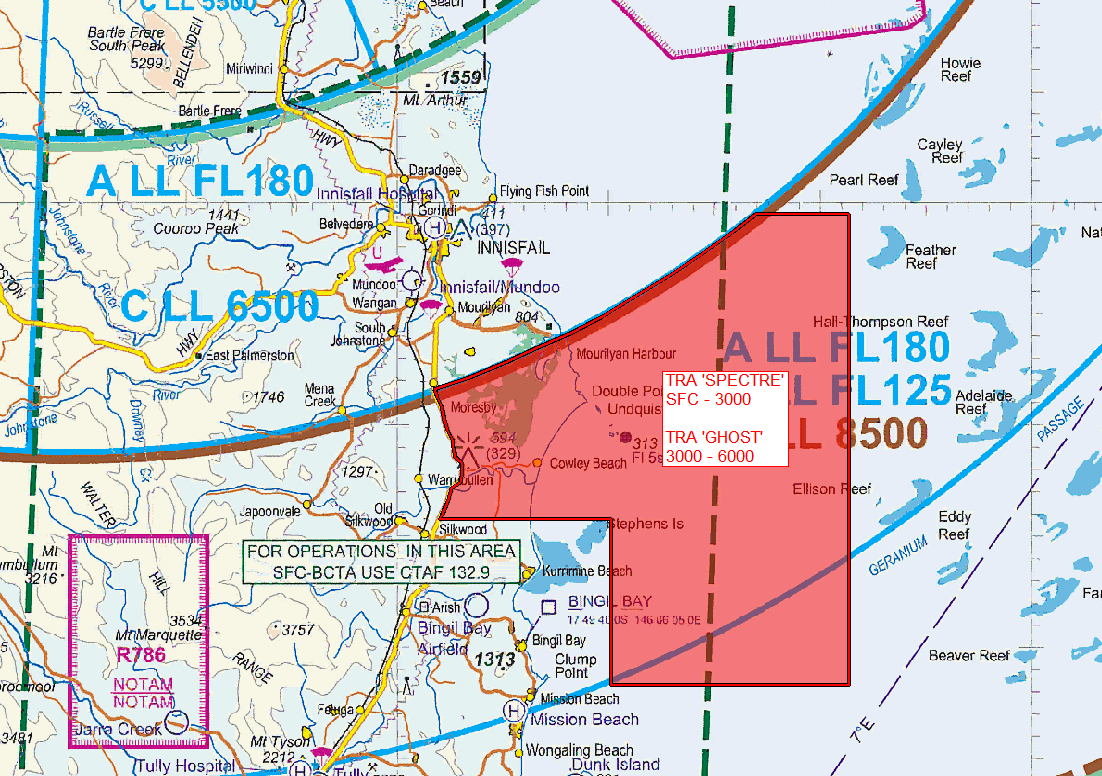
TRA ‘SPECTRE’ and TRA ‘GHOST’
These TRAs provided segregated airspace that allowed a small amphibious exercise the ability to conduct their activities while reducing impost on the Kurrimine Beach parachute drop zone. The western boundary of the Bruce Highway over land provided a clear visual tracking point to avoid the restricted airspace and the northern boundary remained clear of controlled airspace both vertically and laterally.
These airspace volumes shared the same lateral boundaries and were split at 3000 feet (FT) above mean sea level (AMSL) to allow for a clear distinction between restricted area status. TRA ‘SPECTRE’ was designated as RA2 due to the higher density activities occurring and the lower likelihood of receiving a transit clearance while TRA ‘GHOST’ was designated RA1 due to the lower traffic density that would allow the controlling authority to provide safe transit of the volume.
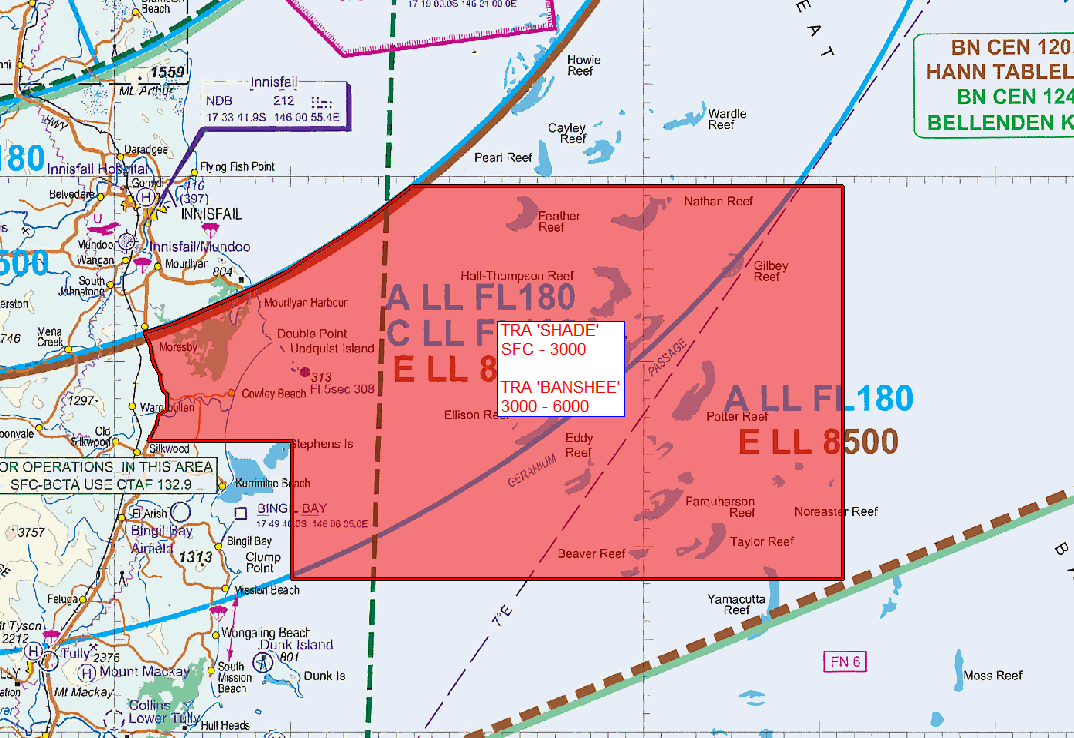
TRA ‘SHADE’ and TRA ‘BANSHEE’
These TRAs utilised the same northern, southern and western lateral boundaries as TRA ‘SPECTRE’ and TRA ‘GHOST’ with an extension of the eastern boundary to provide a more extensive exercise area for larger amphibious task groups. The same vertical concept existed with a split at 3000ft AMSL to allow for a different RA status.
Airspace Design
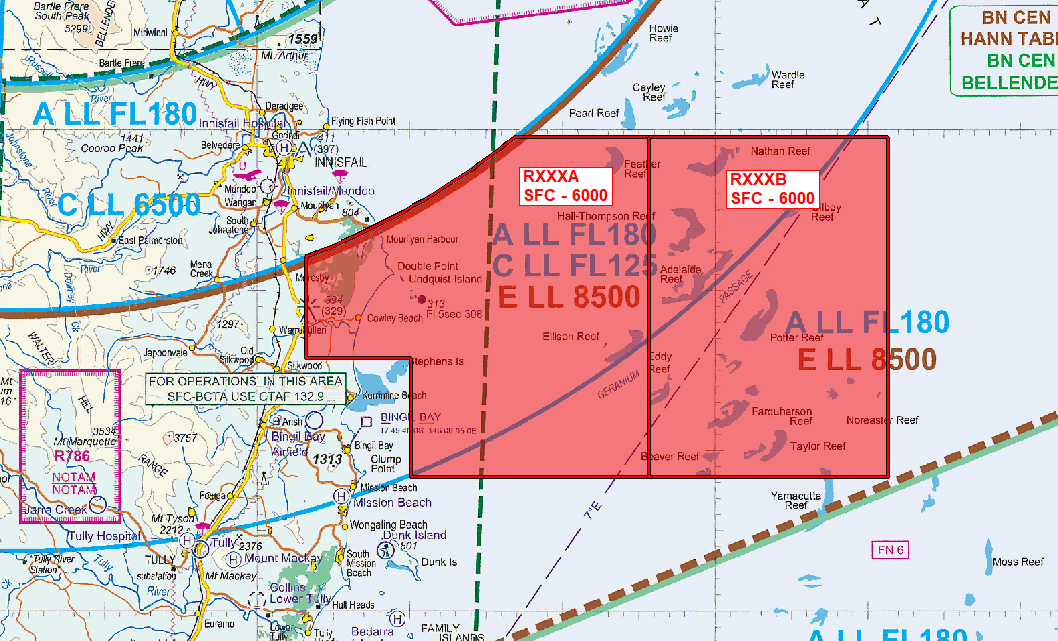
Following a number of activities, Defence has determined the best approach to permanent airspace is to remove the vertical split between the airspace volumes and instead pursue two separate RA volumes. The first volume, RXXXA will provide the option for an exercise area suitable for small to medium amphibious exercises while not taking up excess overwater airspace that is surplus to Defence needs. The second volume, RXXXB will provide the option for extending the exercise area east when the exercise scale warrants.
The western boundary of RXXXA has been amended to a straight line to the east of the Bruce Highway in order to simplify the volume dimensions and continue to provide the western diversion along the highway.
While these permanent volumes will not have a vertical split, it is expected that Defence will only activate the airspace required to reduce any impost upon non-participants. This may result in activations of SFC – 3000ft where exercise traffic allows.
With regards to airspace transits, the feedback received from previous controlling agencies has been that the RA1 transit volume has not been used extensively when activated. Should feedback be received that the aviation community desires this facility, Defence will look to create procedures that can be included in an AIP product to facilitate access when possible.
Airspace Dimensions
RXXXA
Conditional Status: RA2
Military Flying
Lateral Limits: 173754S 1460317E then along the counter clockwise arc of a circle radius 50.00NM centre 165101S 1454438E (YBCS/DME) – 173029S 1461655E – 173029S 1462545E – 175140S 1462545E – 175140S 1461010E – 174412S 1461010E – 174412S 1460317E – 173754S 1460317E
Vertical Limits: SFC-6000 AMSL
Hours of Activity: NOTAM
Controlling Authority: DEFENCE JACC
RXXXB
Conditional Status: RA1
Military Flying
Lateral Limits: 173029S 1462545E – 173029S 1464127E – 175140S 1464127E – 175140S 1462545E – 173029S 1462545E
Vertical Limits: SFC - 6000 AMSL
Hours of Activity: NOTAM
Controlling Authority: DEFENCE JACC
Activation Dates and Timings
Defence envisages that it will activate these volumes by Notice to Airmen (NOTAM) up to twice per year for up to two weeks at a time.
Impact upon Innisfail Instrument Flight Procedures
It is expected that RXXXA will preclude the use of the YIFL IFPs without transit clearance of the airspace volume.
Defence has facilitated transit of the TRA volumes in past exercises for aircraft requiring access to the procedures in instrument meteorological conditions. Defence is supportive of providing the same access during activations of these proposed permanent volumes.
Feedback will be sought from the Airservices Australia Instrument Flight Procedure Design team on the best approach to notifying the aviation community of the infringement.
Priority Access
The following flights will be afforded priority by the Controlling Authority:
- Aircraft operating in the preservation of life or property (MEDEVAC, FFR, POL, SAR)
- Aircraft with a declared emergency, and
- Aircraft conducting an instrument approach to an aerodrome in IFR conditions (i.e. non-training).
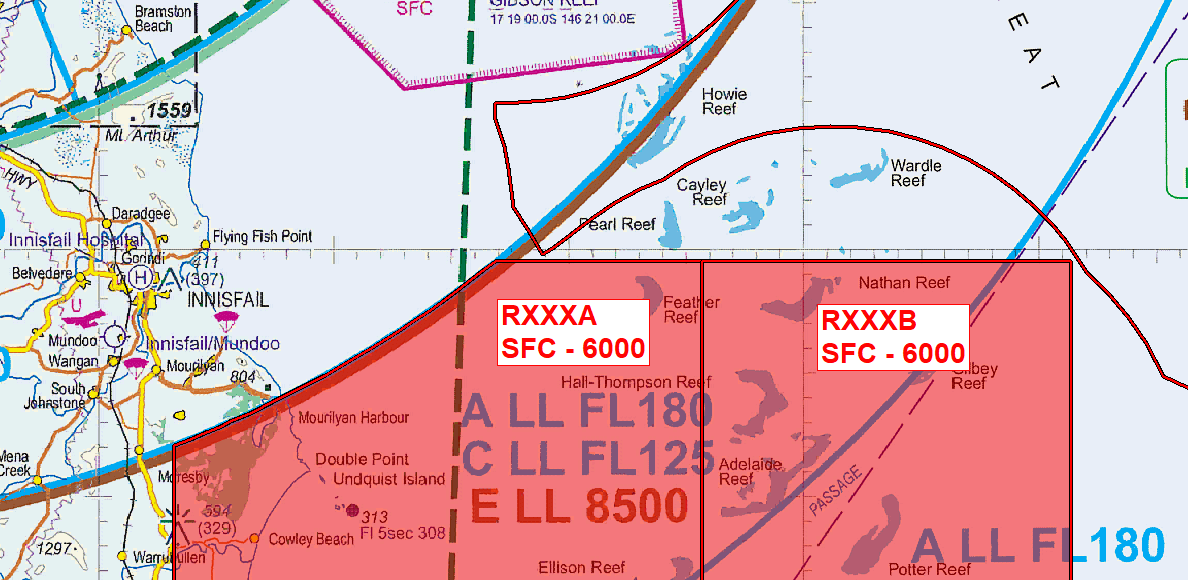
Sovereign Airspace
The proposed airspace volumes remain within Australian sovereign airspace as depicted in Figure 4:
All stakeholders are invited to provide feedback on the proposal to the Joint Airspace Control Cell: adf.airspace@defence.gov.au by 5 Dec 2025.